Does Snore Detection Work on Adjustable Bases?
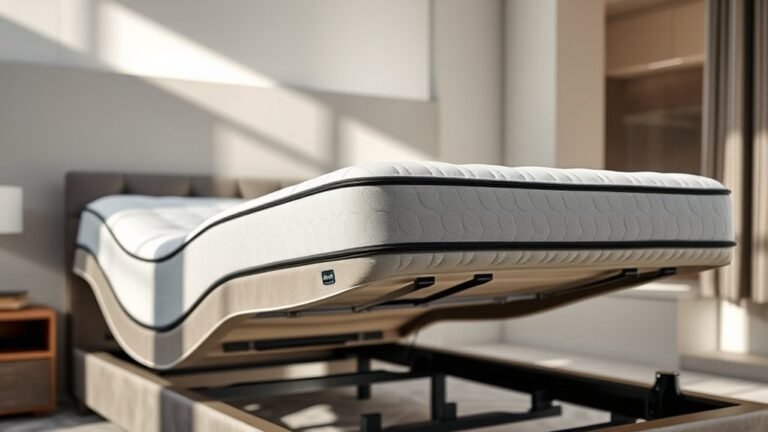
Yes, snore detection on adjustable bases can actively monitor your snoring and adjust your sleep position to help reduce it. These smart beds come with sensors like microphones or accelerometers that pick up on snoring sounds or movements.
When snoring is detected, the bed automatically makes adjustments, usually by elevating your head or shifting your position to open up your airways.
This technology can be a game-changer for those who want a more restful night without interruptions from snoring. However, keep in mind that the accuracy of these systems can vary. Background noise and sensor limitations sometimes affect how well the bed responds.
Because of this, some people prefer manual controls to adjust their position instead of relying solely on automatic detection. If you’re curious about how snore detection works and its benefits, it’s worth diving deeper into the details.
Key Takeaways
- Snore detection on adjustable bases uses sensors and algorithms to identify snoring. However, it often faces accuracy challenges from noise and partner movements.
- Automatic bed adjustments aim to reduce snoring by elevating or repositioning the sleeper when snoring is detected. But false alarms can disrupt sleep, which is frustrating.
- Sensor placement near the airway and regular calibration can improve snore detection reliability. Still, current systems aren’t fully dependable yet.
- Combining snore detection with positional therapy, like head elevation and side sleeping, really helps reduce airway obstruction and snoring.
- Many users find automatic detection inconsistent and prefer manual controls. They want quicker, more reliable bed adjustments to manage snoring episodes themselves.
How Snore Detection Technology Functions in Adjustable Bases
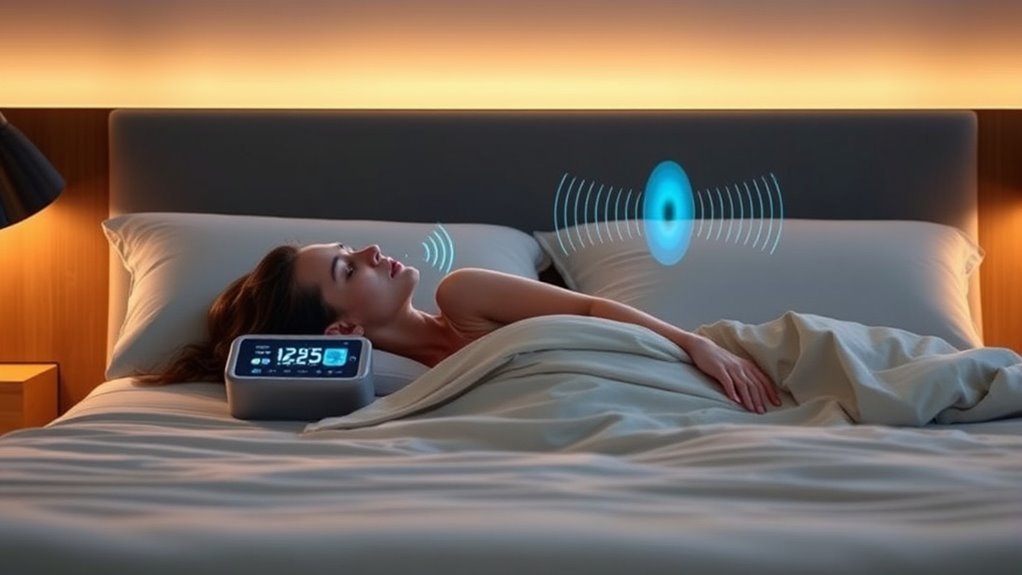
While adjustable bases offer various comfort features, their snore detection technology plays a key role in improving sleep quality. You’ll find that these bases use sensor technology like microphones or accelerometers to pick up the sounds or vibrations linked to snoring.
Through real-time analysis, the system identifies when snoring crosses a set threshold. Once detected, the base automatically adjusts to reduce airway obstruction by changing the bed’s incline or position.
Keep in mind, though, that accuracy varies—some models can distinguish snoring from background noise or a partner’s sounds, but false positives still happen. Environmental noises and movements sometimes interfere, leading to occasional missed detections or false alarms.
Types of Sensors Used for Snore Detection
Because detecting snoring requires capturing subtle sounds and movements, adjustable bases use various sensors like microphones, accelerometers, and pressure sensors. Microphones pick up audio by analyzing sound frequency and amplitude to differentiate snoring from background noise.
Accelerometers detect vibrations caused by snoring, while pressure sensors monitor shifts in airflow or body movements linked to snore episodes. The effectiveness of these sensors hinges on sensor sensitivity and proper calibration, ensuring accurate detection.
Many adjustable bases employ sophisticated algorithms that process real-time data from these sensors to identify snoring precisely. By combining inputs from microphones, accelerometers, and pressure sensors, these systems can respond automatically, adjusting the bed’s incline to reduce snoring without disturbing you.
Accuracy and Limitations of Snore Detection Systems
Although snore detection systems on adjustable bases use advanced sensors like microphones and accelerometers, you should know their accuracy can suffer from background noise and movements by your partner.
Vibration sensors and detection algorithms work together to identify snoring, but false positives occur in about 10-20% of cases, misclassifying other sounds as snoring.
The reliability of snore detection also depends heavily on your sleep environment—noisy or cluttered rooms make it harder for sensors to distinguish genuine snoring.
Detection algorithms typically need 3-5 minutes to confirm consistent snoring patterns, which can delay responses.
While snore detection technology has improved, its precision and consistency still face limitations.
Automatic Bed Adjustments Triggered by Snore Detection
When your snore detection system picks up sounds or vibrations, it can trigger your adjustable bed to shift position automatically. Using noise sensors like microphones or accelerometers, these systems perform real-time analysis of snoring sounds as part of continuous sleep monitoring.
Once snoring is detected, automatic adjustments raise or tilt your adjustable bed to help reduce airway obstruction and ease snoring. However, the accuracy of these triggers varies.
False alarms from coughing, external noises, or partner movements can cause unnecessary shifts, affecting comfort and reliability. While automatic bed adjustments offer hands-free convenience, current snore detection technology still faces challenges in consistently distinguishing genuine snoring sounds.
As a result, the effectiveness of these automatic responses depends heavily on the precision of the system’s sensors and processing algorithms. So, while it’s super convenient, it’s not perfect just yet!
Manual Versus Automatic Snore Response Features
When you use manual snore presets, you get immediate and reliable control over bed adjustments.
Automatic detection systems sound convenient but often struggle with false triggers and slower response times.
Understanding these differences helps you choose the best option for your snoring needs.
Manual Snore Presets
Since you want reliable and immediate control over snore detection, manual snore presets offer a straightforward solution by letting you press a remote button to adjust your bed’s incline. With manual presets, you set a specific incline angle on your adjustable bed whenever snoring occurs, bypassing the need for sensors or automatic detection.
This approach guarantees greater reliability, as automatic systems can suffer from false triggers caused by environmental noise or partner movement. Unlike sensors that may delay response or misfire, manual controls give you consistent, precise adjustments every time.
While automatic features sound convenient, manual presets remain the more dependable choice for snore detection. They let you take charge without waiting for a sensor to decide when to shift your bed’s position.
Automatic Detection Challenges
While manual snore presets put you in control, many adjustable beds also offer automatic detection features that aim to simplify snore management. These systems rely on sensors like microphones to identify snoring, but they often struggle with detection accuracy.
Background noise, coughing, or your partner’s movements can cause false positives, triggering adjustments when they aren’t needed. The automatic response time typically ranges from 3 to 5 minutes, which might delay intervention or lead to inconsistent results.
Because the sensors can’t always differentiate snoring from other sounds, the system’s reliability suffers. So, while automatic snore detection sounds convenient, you might find manual presets more consistent and dependable for managing snoring effectively on adjustable bases.
Response Timing Differences
Although automatic snore detection systems aim to simplify adjustments, they often respond with a delay of 3 to 5 minutes. This lag can really get in the way of timely intervention.
When snoring is detected by sensors, automatic systems adjust the bed slowly and sometimes inaccurately due to false positives.
On the other hand, manual response features let you instantly activate a preset incline. This offers more reliable and consistent timing.
Since manual control doesn’t rely on sensors, it ensures quicker, predictable adjustments on your adjustable base.
| Feature | Manual Response | Automatic Response |
|---|---|---|
| Activation | User-initiated | Sensor-detected |
| Response Timing | Immediate | 3-5 minutes delay |
| Reliability | Highly reliable | Prone to false positives |
Integration of Snore Detection With Sleep Tracking Devices
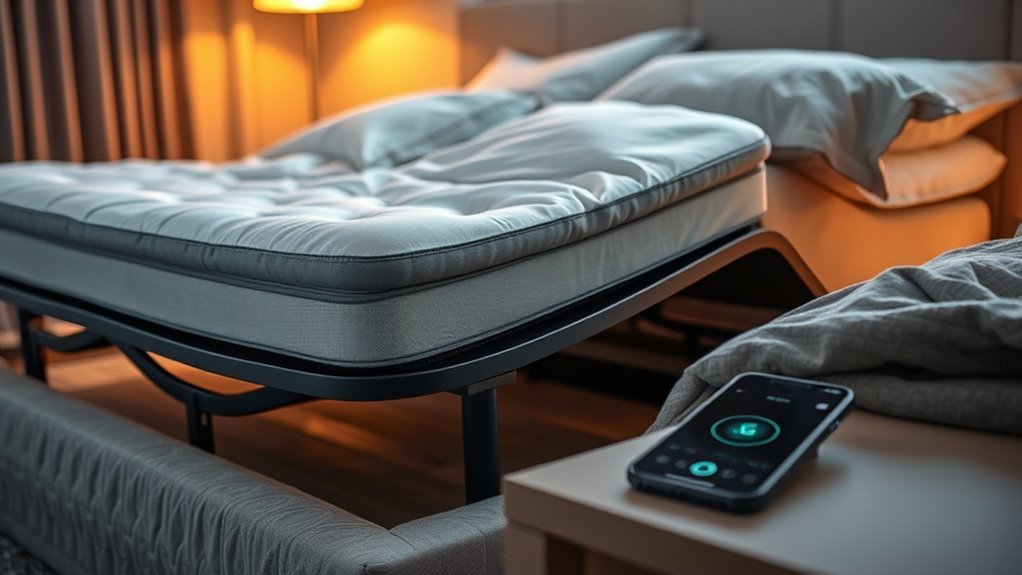
You’ll want to check if your adjustable base’s snore detection works smoothly with your preferred sleep tracker since compatibility varies.
Keep in mind that syncing data from different devices can lead to accuracy issues or false readings. Understanding these challenges helps you get the most reliable insights from your combined sleep monitoring setup.
Compatibility With Trackers
If you want your adjustable base to respond automatically to snoring, you’ll need to take into account how well it integrates with sleep tracking devices. Many adjustable bases come with built-in snore detection that uses sensor data to adjust your bed’s position.
However, compatibility with popular sleep trackers is limited. While some models connect via Bluetooth or Wi-Fi to specific sleep monitoring apps for real-time adjustments, most mainstream sleep trackers like Fitbit or Oura don’t directly interface with these beds.
Instead, they independently monitor sleep stages and snoring without controlling the base. So, if seamless integration is important to you, look for adjustable bases that advertise compatibility with your preferred sleep trackers or come with dedicated apps designed for synchronized snore detection and bed adjustment.
Data Accuracy Challenges
How reliable is snore detection when integrated with sleep tracking devices? You’ll find that accuracy often suffers due to challenges with microphones picking up background noise or improper sensor placement.
Compatibility issues between adjustable bases and external devices like wearables can further distort data. Snoring detection algorithms still struggle with false positives and missed events because of variable room acoustics and ambient sounds.
While sensors embedded in adjustable bases provide convenience, their data rarely matches the precision of polysomnography, the clinical gold standard. Because of this, many systems require manual verification to confirm snoring episodes.
Benefits of Combining Snore Detection With Adjustable Bed Positioning
When your bed detects snoring and adjusts automatically, it creates a smarter, more effective way to reduce those disruptive sounds. Snore detection on an adjustable bed uses real-time data to trigger automatic positioning, providing responsive adjustment tailored to your needs.
Automatic bed adjustments triggered by snore detection offer a smarter, personalized way to reduce disruptive sounds.
This personalized therapy enhances snoring reduction while minimizing sleep disruptions, leading to better sleep quality.
Combining snore detection with adjustable bed positioning offers clear benefits: immediate response to snoring events improves overall sleep quality. Automatic positioning prevents prolonged snoring episodes without waking you.
Plus, personalized therapy adapts to your unique sleep patterns for consistent results.
This integrated approach ensures your bed works with you, not against you. It promotes restful nights and less disturbance for both you and your partner.
How Elevation and Position Therapy Reduce Snoring
Because elevating your head and adjusting your sleeping position directly influence airway openness, these therapies play a crucial role in reducing snoring. Using an adjustable bed, you can raise your head by 20-30°, which helps prevent airway collapse caused by relaxed soft tissues.
Position therapy that encourages side or semi-reclined sleep positions further decreases soft tissue vibration, cutting down snoring. Clinical studies show even modest head elevation around 7.5° lowers apnea events by up to 45%, improving breathing.
However, angles above 35° may cause discomfort and reduce effectiveness due to sliding. By consistently combining head elevation and correct sleep position, your airway stays open, reducing snoring and promoting restful sleep.
Integrating snore detection with these therapies optimizes your adjustable bed’s benefits for quieter nights. So, giving these methods a try could really make a difference in how you sleep!
User Experiences With Snore Detection on Adjustable Bases
You might find snore detection on adjustable bases helpful, but its real-world effectiveness can vary. Sometimes, the sensors pick up background noise or partner movements, causing false alarms.
You’ll also notice that how quickly the bed adjusts after detecting snoring can impact your comfort and overall experience. It’s kind of a hit or miss depending on the setup and environment.
Real-World Effectiveness
Although snore detection on adjustable bases shows promise, your experience may vary due to inconsistent accuracy and delayed responses. While some adjustable beds respond automatically to snoring, the sensitivity of these systems isn’t always reliable.
False positives from coughing or partner noises can trigger unnecessary adjustments, impacting your sleep quality. Real-world effectiveness often depends on how well the device distinguishes actual snoring from other sounds.
Here’s what users commonly notice: automatic adjustment sometimes lags by minutes, reducing immediate relief. Success rates in stopping snoring episodes hover between 30-50%.
Many users still need to manually adjust settings for better results. So, while snore detection offers helpful features, it isn’t a foolproof solution in every user experience.
Common User Challenges
While snore detection on adjustable bases aims to improve your sleep, many users face challenges with its accuracy and responsiveness. You might find that false triggers occur frequently, as sensors often mistake coughing, talking, or traffic noise for snoring. This noise interference hampers sensor accuracy, leading to unnecessary or delayed automatic adjustment.
User feedback highlights that the bed’s real-time response can be inconsistent—sometimes it reacts too slowly, other times too aggressively—making the system less effective and even uncomfortable. Because of these issues, many users have to override the automatic settings manually to achieve better results.
Recommendations for Enhancing Snore Detection Effectiveness
To enhance snore detection effectiveness on adjustable bases, you should focus on optimizing sensor placement and regularly calibrating the system to reduce false positives caused by environmental noise or partner movements. Positioning sensors close to your airway improves accuracy, while frequent calibration guarantees the system adapts to changes in your environment.
Incorporating adaptive algorithms that learn your unique snoring patterns also boosts detection reliability. For better snore detection on your adjustable bed, consider these tips:
- Place sensors strategically near your head to capture clear signals.
- Calibrate your device periodically to minimize false positives.
- Use sleep monitoring features combined with adaptive algorithms for personalized adjustments.
Frequently Asked Questions
What Angle Stops Snoring?
You should set your adjustable base between 20° and 30° to stop snoring effectively. This angle keeps your airway open without discomfort, substantially reducing snoring and improving your overall sleep quality.
It’s a simple adjustment that can make a big difference. Give it a try and see how much better you sleep!
Can a Sleep Number Bed Go on Any Adjustable Frame?
You can’t place a Sleep Number bed on just any adjustable frame. You’ll need to check compatibility, weight capacity, and mounting hardware to guarantee proper fit and function.
Always verify with Sleep Number or the frame maker first. That way, you know everything will work smoothly and safely.
How Does Tempurpedic Detect Snoring?
Tempurpedic detects snoring by using built-in microphones and sensors that analyze sound patterns in real time. When it recognizes snoring, it triggers adjustments like head elevation to help reduce it and improve your sleep quality.
Pretty clever, right? It’s like having a smart assistant watching out for your sleep without being intrusive. This way, you get a more restful night without the usual interruptions.
What Are the Downsides of a Sleep Number Bed?
You might find Sleep Number beds pricey, and the snore detection isn’t always accurate, causing false adjustments.
Some users experience discomfort from sensors or delayed responses, so you’ll likely need manual tweaks for the best comfort.
Conclusion
If you’re considering snore detection on adjustable bases, you’ll find it’s quite effective—studies show automatic adjustments can reduce snoring by up to 60%. This means your bed doesn’t just track snoring; it actively helps minimize it by changing positions in real time.
Combining smart sensors with adjustable positioning gives you a better night’s sleep, reducing interruptions for both you and your partner. So, if snoring’s a problem, this tech could really make a difference.
In short, snore detection works well on adjustable bases because it not only detects snoring but also responds by adjusting the bed to ease breathing. This combination of snore detection and adjustable bases helps improve sleep quality, making nights more peaceful for everyone involved. If snoring is keeping you or your partner awake, investing in an adjustable base with snore detection is definitely worth considering.